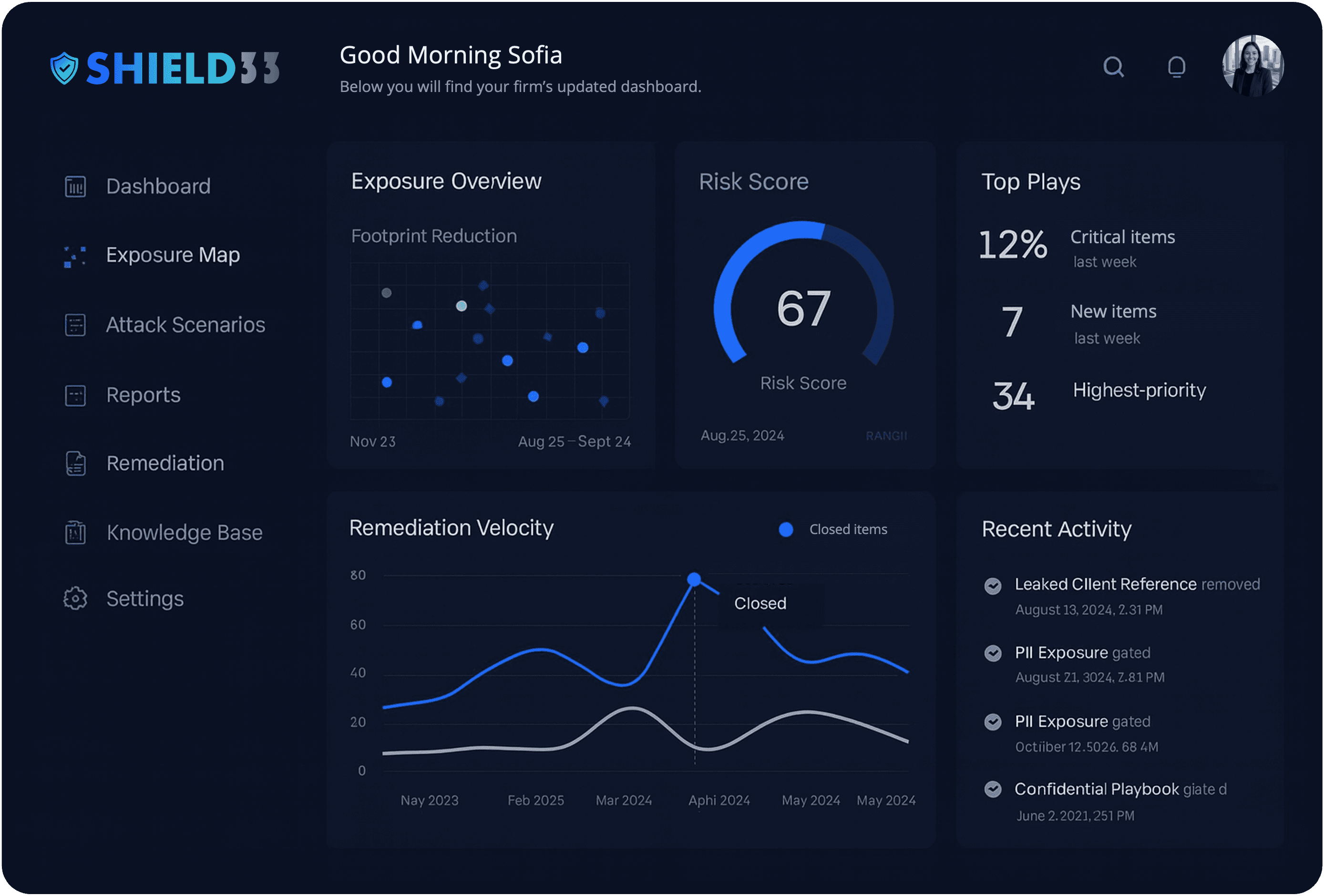

PROTECT CLIENT TRUST
Protect Your Business From
Sensitive Data Leaks
Business-Context External Attack Surface Management (EASM) platform to monitor sensitive data unintentionally exposed on the open web — helping you prevent confidentiality breaches, sophisticated AI-driven social engineering attacks, and reputational damage.
Sensitive data leaks are happening on your watch.
Quietly. Publicly. Right now.
Confidential Client Names
Leaked references to clients, partners, and vendors that quietly violate confidentiality agreements, erode trust and reputation, and show attackers exactly where to aim.
Confidential Client Names
Leaked references to clients, partners, and vendors that quietly violate confidentiality agreements, erode trust and reputation, and show attackers exactly where to aim.
Confidential Client Names
Leaked references to clients, partners, and vendors that quietly violate confidentiality agreements, erode trust and reputation, and show attackers exactly where to aim.
People & Identity Data
Exposed Personally Identifiable Information (PII) from executives and staff—emails, phone numbers, roles, and org charts—that bad actors can easily weaponize in sophisticated AI-powered social-engineering attacks.
People & Identity Data
Exposed Personally Identifiable Information (PII) from executives and staff—emails, phone numbers, roles, and org charts—that bad actors can easily weaponize in sophisticated AI-powered social-engineering attacks.
Internal Documents
Internal documents with leaked pricing, SLAs, and runbooks that hand attackers and competitors the details they need to target and pressure your business.
Internal Documents
Internal documents with leaked pricing, SLAs, and runbooks that hand attackers and competitors the details they need to target and pressure your business.
Built for CISO and Chief Legal Officer teams at 100+ FTE professional services firms, Shield33 turns sensitive data leaks into a prioritized remediation backlog so you can prevent confidentiality breaches, reduce exposure to sophisticated AI-powered social-engineering attacks, and prove to clients and the board that you’re in control.
Protect Client Confidentiality
Proactively detect leaked client and partner references across your public footprint, tie them to NDAs and MSAs, and remove or gate them before they become quiet contract breaches.
C

Protect Client Confidentiality
Proactively detect leaked client and partner references across your public footprint.
C
Protect Client Confidentiality
Proactively detect leaked client and partner references across your public footprint.
C
Shrink Your Social-Engineering Attack Surface
See exactly how exposed client names, people data, and internal docs can be weaponized in phishing, invoice fraud, and impersonation—and close the specific artifacts that make those attacks believable.

Your Company

Bad Actor
Invoice Fraud
Email Compromise
Expense Fraud
Payroll Fraud
Credential Theft
Supply Chain Fraud
Shrink Your Social-Engineering Attack Surface
See exactly how exposed client names, people data, and internal docs can be weaponized in phishing, invoice fraud, and impersonation—and close the specific artifacts that make those attacks believable.
Your Company
Bad Actor
Invoice Fraud
Email Compromise
Expense Fraud
Shrink Your Social-Engineering Attack Surface
See exactly how exposed sensitive data can be weaponized in phishing, invoice fraud, and impersonation—and close the specific artifacts that make those attacks believable.
Your Company
Bad Actor
Invoice Fraud
Email Compromise
Expense Fraud
Always-On Monitoring
Turn on Shield33’s radar once and continuously scan your public footprint, automatically flagging new sensitive-data leaks the moment they appear on the open web.
See Incidents
Monthly Incidents
Last 24hrs

Your Company
Manage Incidents
Full Public-Footprint Coverage
Smart De-Duplicated Alerts
Automatic Tickets & Ownership
Always-On Monitoring
Turn on Shield33’s radar once and continuously scan your public footprint, automatically flagging new sensitive-data leaks the moment they appear on the open web.
See Incidents
Monthly Incidents
Last 24hrs
Your Company
Manage Incidents
Full Public-Footprint Coverage
Smart De-Duplicated Alerts
Automatic Tickets & Ownership
Always-On Monitoring
Turn on Shield33’s radar once and continuously scan your public footprint, automatically flagging new sensitive-data leaks the moment they appear on the open web.
See Incidents
Monthly Incidents
Last 24hrs
Your Company
Manage Incidents
Full Public-Footprint Coverage
Smart De-Duplicated Alerts
Automatic Tickets & Ownership
Prove You’re in Control
Turn your monitoring into a defensible story for your board and auditors — showing what was exposed, how it could have been abused, and the concrete actions your teams took to fix it.
Incident
Found
Owner
Impact
Client Ref.
Dec 4th
Olivia Carter
$$$$
Conf. Doc.
Nov 28th
Priya Desai
$$$
Financials
Dec 17th
Alicia Park
$$$$$$$
Pricing
Jan 28th
David Kim
$$
Partner Ref.
Mar 17th
Lily Stone
$
P.I.I.
Oct 10th
Zoe Clark
$$$$$$$
Prove You’re in Control
Turn your monitoring into a defensible story for your board and auditors — showing what was exposed, how it could have been abused, and the concrete actions your teams took to fix it.
Incident
Found
Impact
Client Ref.
Dec 4th
$$$$
Conf. Doc.
Nov 28th
$$$
Financials
Dec 17th
$$$$$$$
Pricing
Jan 28th
$$
Partner Ref.
Mar 17th
$
P.I.I.
Oct 10th
$$$$$$$
Prove You’re in Control
Turn your monitoring into a defensible story for your board and auditors — showing what was exposed, how it could have been abused, and the concrete actions your teams took to fix it.
Incident
Found
Impact
Client Ref.
Dec 4th
$$$$
Conf. Doc.
Nov 28th
$$$
Financials
Dec 17th
$$$$$$$
Pricing
Jan 28th
$$
Partner Ref.
Mar 17th
$
P.I.I.
Oct 10th
$$$$$$$
FEATURES
Capabilities Built for Security & Legal
From public-footprint mapping and PII detection to live alerts, remediation workflows, and audit-ready trails, these features turn outside-in monitoring into a repeatable part of your risk program.
Analytics & KPIs
Track MTTR, exposure trends, top offending sources, remediation velocity, and team performance.
Analytics & KPIs
Track MTTR, exposure trends, top offending sources, remediation velocity, and team performance.
Public footprint map
See every public domain, subdomain, file, and employee-generated asset with risk scoring and ownership correctly mapped.
Public footprint map
See every public domain, subdomain, file, and employee-generated asset with risk scoring and ownership correctly mapped.
PII + Metadata Tracking
Detect exposed PII and sensitive metadata across publicly exposed documents, images, and PDFs.
PII + Metadata Tracking
Detect exposed PII and sensitive metadata across publicly exposed documents, images, and PDFs.
Live Alerts with Noise Control
Receive real-time alerts with deduplication, severity routing, suppression windows, and channel preferences to reduce noise.
Live Alerts with Noise Control
Receive real-time alerts with deduplication, severity routing, suppression windows, and channel preferences to reduce noise.
Incident & Remediation Workflows
Assign owners, SLAs, and fix steps; push to Jira/ServiceNow; auto-verify closure and metrics on completion.
Incident & Remediation Workflows
Assign owners, SLAs, and fix steps; push to Jira/ServiceNow; auto-verify closure and metrics on completion.
Audit Trails
Produce timestamped evidence packs with URLs, screenshots, chain-of-custody, and immutable audit trails for compliance reporting.
Audit Trails
Produce timestamped evidence packs with URLs, screenshots, chain-of-custody, and immutable audit trails for compliance reporting.
Whitelisting Rule Management
SAML SSO
24-month Evidence Retention
Confidential Docs Discovery
Ticketing & SIEM Integrations
Real-Time Automation
Roles & Permissions
Remediation Email Notifications
Social-Engineering Scenario Engine
Executive & Staff PII Shielding
CUSTOMER STORIES
Trusted by Security & Legal Leaders
Why CISOs and Chief Legal Officers at top services firms now treat Shield33 as a core part of their risk program.
Attackers now build social-engineering campaigns from tiny fragments of public data. Shield33 continuously surfaces those fragments for us and turns them into an actionable backlog. It’s one of the few tools I can point to and say: this clearly reduces our risk.

Daniel K.
Regional CISO, EMEA
Attackers now build social-engineering campaigns from tiny fragments of public data. Shield33 continuously surfaces those fragments for us and turns them into an actionable backlog. It’s one of the few tools I can point to and say: this clearly reduces our risk.
Daniel K.
Regional CISO, EMEA
Our mandate is to protect client confidentiality across a growing digital footprint. Shield33 gives us a live map of where sensitive references and people data appear online, and how they could feed AI-driven impersonation. That lets us proactively remove or gate those exposures before they turn into confidentiality breaches or contractual issues with key clients and partners.

Christophe S.
Compliance & Legal
Our mandate is to protect client confidentiality across a growing digital footprint. Shield33 gives us a live map of where sensitive references and people data appear online, and how they could feed AI-driven impersonation. That lets us proactively remove or gate those exposures before they turn into confidentiality breaches or contractual issues with key clients and partners.
Christophe S.
Compliance & Legal
AI-driven phishing has raised the bar for what ‘good enough’ looks like. Shield33 connects public exposure to realistic fraud scenarios, so we can brief senior leadership in concrete terms: here are the attack plays, what we’ve already closed, and what’s next.

Cintia N.
Data Protection Director
AI-driven phishing has raised the bar for what ‘good enough’ looks like. Shield33 connects public exposure to realistic fraud scenarios, so we can brief senior leadership in concrete terms: here are the attack plays, what we’ve already closed, and what’s next.
Cintia N.
Data Protection Director
“ Attackers are increasingly using bots and machine-speed tools to scan for vulnerabilities and launch phishing campaigns at scale. This shift has made phishing more dangerous than ever. „

Derek Manky, VP of Threat Intelligence, Fortinet
FAQ
What exactly does Shield33 monitor?
Shield33 continuously scans your public digital footprint: corporate websites, microsites, marketing assets, cached files, public storage, portfolios, slide decks, PDFs, and other employee-generated content that’s accessible from the open web. It’s not an endpoint or email-security product; it’s an outside-in lens on where sensitive client references, people data (PII), and internal documents have unintentionally leaked.
Do you scan our internal systems, email, or endpoints?
No. Shield33 is strictly outside-in. We do not access or scan your internal systems, inboxes, endpoints, or private storage. We only work with data that is already publicly reachable (often unintentionally) and therefore already available to attackers, search engines, and automated crawlers.
What types of sensitive data can Shield33 detect?
Shield33 focuses on the three categories that most easily fuel confidentiality breaches and social-engineering attacks: • Confidential client & partner references (names, logos, project descriptions, case studies) • People / identity data (executive and staff PII such as names, roles, emails, phone numbers, org charts) • Internal documents & playbooks (pricing, SLAs, runbooks, escalation paths, tooling details)
How is Shield33 different from traditional vulnerability scanning or DLP?
Traditional tools focus on technical issues (ports, patches, misconfigurations, malware, data exfiltration from inside the network). Shield33 focuses on the human and reputational layer: • What sensitive business context have you exposed publicly? • How could a capable attacker combine those artifacts into phishing, fraud, or impersonation campaigns? • Where are you at risk of quiet confidentiality breaches even before an attack occurs? We complement, not replace, your existing vuln management, EDR, or DLP stack.
How does the “attack scenario” engine work?
Once Shield33 discovers exposed artifacts, it: 1. Classifies them (e.g., confidential client, rate card, SLA, PII, internal runbook). 2. Links related artifacts into plausible “plays” an attacker could run (invoice fraud, SaaS/support impersonation, executive phishing, vendor spoofing, etc.). 3. Scores each scenario on likelihood/impact and maps it to the exact public evidence that enables it. You get a ranked list of scenarios—not just raw hits—so you can prioritize remediation and executive communication.
What about privacy, data protection, and regulatory compliance?
Because Shield33 only analyzes data that is already public, we do not increase your regulatory exposure—we help you discover and reduce it. For any data we process: • Data is handled under strict security controls and regional hosting choices. • Findings are tied back to your existing legal and compliance frameworks (NDAs, DPAs, industry-specific regs). • You can configure what categories to flag, store, or ignore based on your policies. We’re happy to support DPIAs, vendor risk assessments, and security questionnaires as part of your onboarding.
Which types of organizations get the most value from Shield33?
We’re built primarily for professional services and knowledge-intensive firms where: • Client relationships and reputation are core assets. • Employees frequently publish content (case studies, decks, talks, repos, portfolios). • There is a high density of sensitive client, deal, and people data spread across the web. Typical examples: consulting and advisory firms, IT and cloud services providers, systems integrators, law firms, marketing/creative agencies, and specialized B2B service providers.
What exactly does Shield33 monitor?
Do you scan our internal systems, email, or endpoints?
What types of sensitive data can Shield33 detect?
How is Shield33 different from traditional vulnerability scanning or DLP?
How does the “attack scenario” engine work?
What about privacy, data protection, and regulatory compliance?
Because Shield33 only analyzes data that is already public, we do not increase your regulatory exposure—we help you discover and reduce it. For any data we process: • Data is handled under strict security controls and regional hosting choices. • Findings are tied back to your existing legal and compliance frameworks (NDAs, DPAs, industry-specific regs). • You can configure what categories to flag, store, or ignore based on your policies. We’re happy to support DPIAs, vendor risk assessments, and security questionnaires as part of your onboarding.
Which types of organizations get the most value from Shield33?
We’re built primarily for professional services and knowledge-intensive firms where: • Client relationships and reputation are core assets. • Employees frequently publish content (case studies, decks, talks, repos, portfolios). • There is a high density of sensitive client, deal, and people data spread across the web. Typical examples: consulting and advisory firms, IT and cloud services providers, systems integrators, law firms, marketing/creative agencies, and specialized B2B service providers.
PROTECT CLIENT TRUST
Turn Public Exposure Into A Controlled Risk
Give security and legal an outside-in map of leaks, attack paths, and remediation status.